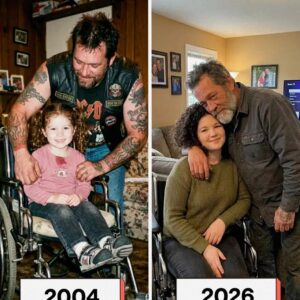
I’m 54 years old, and I’ve lived in a wheelchair for nearly two decades. The accident
happened when my son, Liam, was almost five. One second I was standing, the next my life
changed forever. His father had already walked out when Liam was six months old, saying
he couldn’t handle the responsibility, so it was just the two of us from the very beginning.
After the accident, my world became smaller and more complicated, measured in ramps, narrow
doorways, and learning how to do ordinary things from a seated position. I had to relearn how
to cook, how to reach shelves, how to exist in a world that wasn’t built for me. But through all of it,
Liam was there, small and gentle, bringing me blankets, making me simple sandwiches,
and sitting beside me to say everything would be okay, even when neither of us fully understood what had been taken from us.
I worked from home as a freelance writer, which wasn’t glamorous but kept us afloat and allowed
me to be present for every part of Liam’s life. I never missed a school pickup, a homework session,
or a bedtime story. I watched him grow from a compassionate little boy into a young man
I was deeply proud of. When he went to college and later started a career in marketing,
I felt like all the sacrifices had been worth it. Then he met Jessica. She was polished,
wealthy, and effortlessly put together, the kind of woman whose life looked curated for social media
. When Liam told me they were engaged, I cried with happiness. I immediately began planning,
buying a dress that would look elegant while I was seated, practicing getting in and out
of the car quickly, and even choosing a mother-son dance song. I imagined us together on the dance floor, smiling, surrounded by love.
A week before the wedding, Liam came over alone. He couldn’t meet my eyes when he spoke.
He told me they had chosen a historic chapel on a cliff overlooking the ocean, but that
adding a ramp would ruin the aesthetic. Then he said something that broke me: my wheelchair
itself would be distracting, an eyesore in the photos. Jessica didn’t want anything that
would pull attention away from the “perfect” visual. He asked me not to make it a disability
issue and told me they had decided to give the mother-son dance to Jessica’s mother because
it would look better on camera. I told him I understood, but quietly admitted I never
thought I’d be something he’d feel the need to hide. After he left, I sat in silence,
packed away the dress, deleted the song from my playlist, and didn’t move my wheelchair for the rest of the night.
The next morning, I knew exactly what I needed to do. I spent two days preparing a gift
and asked my brother to deliver it to Liam just before the ceremony. On the wedding day,
I stayed home, staring at the clock. When my phone rang, Liam’s voice was broken.
He told me he had opened the gift, stopped the ceremony, and sent everyone home.
Fifteen minutes later, he was at my door, still in his tuxedo, sobbing.
In his hands was a photo album filled with memories of his life and, at the end,
old newspaper clippings explaining the truth I had never told him: I had been
struck by a car while pushing him out of harm’s way. He lived. I never walked again.
He collapsed in front of me, overwhelmed by guilt, apologizing for being ashamed of
my wheelchair and for trying to erase me from his wedding. I told him I hadn’t sent
the album to make him feel guilty, only to show him the truth—that my wheelchair wasn’t
a symbol of shame or burden. We cried together for a long time. In the days that followed,
Liam ended his engagement, realizing he couldn’t build a life with
someone who asked him to hide his mother. I didn’t send that gift out of spite.
I sent it because he needed to know that love, sacrifice, and dignity should never be hidden for the sake of aesthetics.